Turkey, Fall 2025
A VISIT TO
TURKEY, SEPTEMBER-OCTOBER 2025
Cats in Istanbul are living differently from the way
they were when I lived there in 1981-1982. It used to be that cats were
third-class citizens; now they rule the streets and alleys. In the old days, if
you were walking by a trash dumpster, especially at night, you could sense
something moving in the corner of your eye. It was one or more cats, hustling
for their livelihood.
Not so, anymore. Cats used to be wan and scruffy, skilled at keeping out of the
way, and not particularly clean. They weren't happy and healthy. It was a sad
thing to behold. Now, the cats of Istanbul are well-fed, clean, and calm. They'd
just as soon lie in the middle of your path as elsewhere, because they know
you're going to step around them. There are cats sitting on motorcycles and car
hoods; cats in the dry cleaners; cats under the tables of the sidewalk cafes; a
small herd of cats congregating under the lamplight on an out-of-the-way sokak
late at night. (The only thing I didn't observe was cats driving Cadillacs to
Kayseri.)
It's intriguing to think of how this cultural change took place.
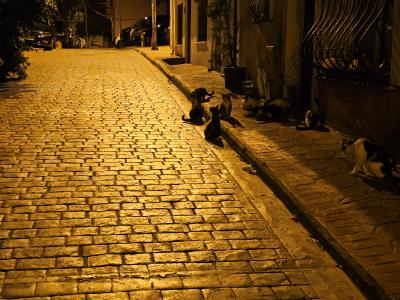
Night Cats of Kumrulu Sokağı
When Leslie and I arrived in Cihangir, a pleasant, hilly
neighborhood below Taksim Square, there were a dozen-odd cats lounging around
Kumrulu Sokak near our apartment. They didn't appear to be associated with a
particular home, other than that street. As we walked through the neighborhood,
we noticed that people had built little houses for the street cats here and
there. People were leaving small piles of cat food out for them.
It was clear that somewhere along the line, people had developed empathy for the
cats of the city. In fact, in one of the tourist neighborhoods there were a
couple of devices the size of a cigarette machine—they were cat food dispensers.
You could put in a coin from anywhere in the world, and a handful or two of cat
food would drop into the receptacle below. That bin was full whenever we passed
it.
Speaking of cats reminds me of the time, in the early 1980s, when I saw a lion
in Istanbul. In fact, in the same day I saw a lion, a bear, and some sheep. I'm
not sure you could see this again. I saw the sheep being tended on the lawn by a
mosque. This was a time of heavy immigration from the villages, and someone had
brought their sheep with them.
Later in the day I was on a bus to one of the outer neighborhoods to visit a
friend. I saw a man walking with a bear along the side of the highway. This was
not as unusual as it sounds—there were Roma who had trained bears to dance and
entertain the public in the streets, as a way of making money. I had seen the
same thing in Novi Sad around that time.
In the evening I went to visit a friend in an apartment building on
Aslan Yatağı
Sokağı, or
Lion's Bed Alley. From the window of my friend's upper-floor apartment, I looked
over to the roof of the neighboring building. Next to the penthouse was a lion,
apparently someone's "pet." You don't have to believe this, but I saw it with my
own eyes.
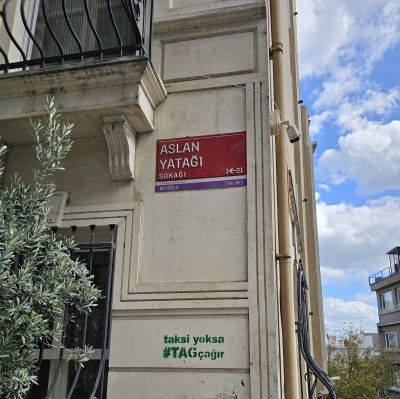
Street sign:
"Aslan Yatağı Sokağı" (Lion's Bed Street)
Istanbul has come
a long way in 43 years, or even in the 22 years since I was last there. The
inner neighborhoods around my old haunts—Beşiktaş,
Nişantaş, Istiklal, are all high-rent
zones now. The latter two sections are full of fancy shops.
Beşiktaş still has a working-class atmosphere, but it's nowhere near as
down-to-earth as before. There used to be a pedestrian overpass crossing the
main road along the Bosphorus. On occasion there was a man whose rabbit would
pick out a printed fortune for you from a box. The man and the rabbit are gone.
The overpass is gone too. So is the open-air market that used to be the
centerpiece of Beşiktaş.
Yıldız Park
is still lovely,
as is
Gülhane
Park near the Aya Sofia mosque.
That 4th-century cathedral had been converted into a mosque when the Ottomans
took over Constantinople in the 15th century. Then, from the time of Atatürk,
and for
decades after, it was a museum; now it has been converted back into a mosque,
over the objections of many people.
The lovely townlets along the Bosphorus eastwards towards the Black Sea are
also nearly unrecognizable; what had been simple and unassuming before, now has
been gentrified and made "classy."
Clearly, a middle class with its upwardly mobile sensibilities has burgeoned in
the last couple of generations. There are still plenty of down-to-earth
neighborhoods and ordinary family-run eateries in Istanbul, but you have to move
a little out of the center to find them.
We went across the straits to the "Asian side" to find our friend Hilmi, who
took us up the hill to
Büyük
Çamlıca.
If you go to Istanbul, you should set aside a few hours to go there, and if you
don't go there, I will hold a slight grudge about it. From there, you can see
all of the big city across the Bosphorus. It's a pleasant park with a couple of
welcoming restaurants and tea joints. We sampled our first
gözleme
there: a
slab of pita bread with melted cheese (and sometimes fancier garnishments). I
hope I don't offend anyone by saying it's a Turkish quesadilla.
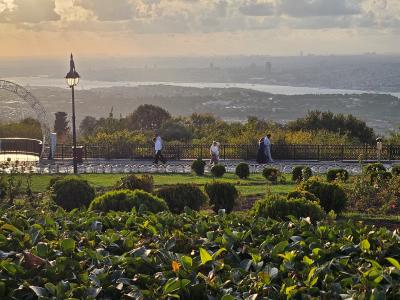
View of Istanbul from
Büyük Çamlıca
Back on
the European side, we walked down the hill through Karaköy,
over the Galata bridge, and up to
Mısır
Çarşısı,
the Spice Bazaar. We visited the big historical mosques and, a couple of times,
the Covered Bazaar.
You can't not go to these places, at least once. But were not only doing the
tourist thing in Istanbul and the rest of Turkey. It was Leslie's first time
there, but we had old friends to visit and, along the way, I was recapturing a
long-lost, intensive relationship with the country. I had had some formative
experiences in Turkey when I lived there at the quite (for me) innocent age of
30. But over the years, I had let some of that connection fade away, simply by
holding to other priorities.
Music, friends, the language, and aspects of the culture were all things I
experienced deeply in the 1980s and for some time after that—but I got
distracted by, let's say, other projects. So, as Leslie was quickly falling in
love with Turkey, as I had done in 1982, I was recapturing my identification
with the country, with resolve to hold onto it more closely.
*
The way I entered Turkey in that spring of 1982 was rather by chance and without
a plan. After having lived in Vojvodina, Yugoslavia, for nearly a year, studying
music and language, I packed up and resolved to do the same or similar in
Greece. I thought it would be "cool" to become a bouzouki player and all that. I
was in Greece for a couple of months without quite hitting the right
combination, when Susan A, doing her doctoral fieldwork in ethnomusicology in
Epirus,
asked me if I would like to ride with her to Turkey to visit our mutual friend
Irene M., who was doing her ethno doctoral fieldwork in Istanbul.
We piled into her baby blue VW and drove through Thrace to Turkey. Somehow I was
ready to fall in love with the country as we crossed the border. It helped that
Irene immediately introduced us to her beautiful friends, musicians and singers
all. She took us to concerts. One thing led to another, and I was settled in
Turkey for most of the next year.
I took up with a number of musicians as teachers and friends. These were young
people with promising careers ahead of them. Some of them were finishing their
studies at one of the city's conservatories. In the next decades they became
performers at the radio station TRT, and/or teachers at the conservatory. They
rose to the top of their fields and, lately, retired. These old friends of mine
are still productive, however, teaching, leading choirs, performing, and
recording.
In addition to this, while I was living in Istanbul one of my very best friends
was Veli Yay, a builder of bağlamas,
more
commonly called "saz." He built most of the sazes that I have today. Several
times a week I would go sit in his workshop as he would plane and assemble parts
of an instrument. That little shop doubled as a social scene for friends,
neighbors, and musicians. Someone would wander in and pick up a saz and just
play. A boy from up the street would come in with tea for everyone. This setting
was a good venue for me to work on my Turkish—in a time when, unlike today, few
people knew English.
Leslie and I visited with Veli and his daughter, going for a snack on the
waterfront in
Beşiktaş. It was good to catch up with them after so many years.
We also got in touch with Rüstem Avcı,
one of my pals
from those days. I probably met
Rüstem
at Veli's shop, and we became close. At the time, he was a young and aspiring
singer with a fine high tenor voice. His ancestors had come to Turkey from
Bulgaria at a time when the post-WWII government was making the Turkish
population of that country feel unwelcome. Given this background, Rüstem was
particularly interested in the body of Turkish folk songs, "Rumeli türküleri,"
from "Batı Trakya"
(western Thrace), as they call the formerly Ottoman-occupied parts of southeast
Europe. That is a rich source of music, and
Rüstem
took that thread and developed it into a career. You can hear a couple of his
more recent performances
here
and
here.
Rüstem picked us up and generously drove us clear across Istanbul to Bakırköy,
to what he considered the best fish restaurant in town. There, we caught up on
old times, which all of a sudden did not feel so old. It was as if only months,
not decades, had passed by. Later,
Rüstem
took us to a choir practice, and then to meet his friends
Parisa
Karamnezhad and Ahad Saadi, both transplanted Iranians from Tabriz, and high-end
artists with a special story.
We met Parisa and Ahad at their gallery in
Maçka,
a neighborhood next to Beşiktaş.
Parisa is a
painter and a singer, and
Rüstem's student. We sat and drank tea, and Rüstem and Parisa
performed a beautiful song
for us. Parisa was sitting under a framed portrait of a lion, created not with
paint, but with fabric. This is Ahad's specialty, and Rüstem let us know that he
was quite successful in this medium—enough to have another gallery, in Venice.
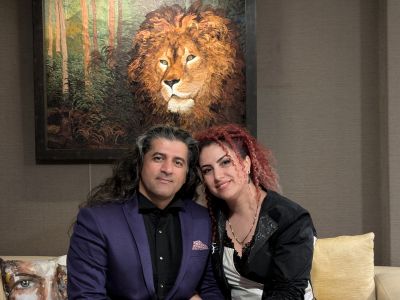
Ahad and Parisa
After a
while Ahad came out to meet us, tall and handsome with long graying hair and a
dignified air. The pair, seemingly aristocracy of the art world, nevertheless
greeted us with respect, as they sat and explained to us the legendary way that
they met. Ahad told us that his mother had, at some point, urged him to stop
being a bachelor and get married. Ahad responded by painting a portrait of the
(to him) ideal woman that he would like to meet. That portrait was on display at
an exhibition, and Parisa, not having met Ahad, came to the exhibition with her
then-boyfriend. Someone noticed that the portrait was a surprisingly close
likeness to Parisa.
Quite some time passed before Parisa and Ahad met again, after Parisa had
separated from her boyfriend. More than a year later, Ahad sought her out and
the two had dinner. Ahad proposed to her on the spot. Parisa asked for some time
to think about it—but she consented the very next day.
The relationship seems as harmonious and successful as it is romantic. The two
share gallery space, with intriguing and creative paintings by both of them. You
can read the enchanting story of their beginnings
here,
and visit their gallery, virtually,
here.
Leslie and I also got together with Erdoğan
Eskimez, one of my saz teachers.
It was good to
reunite with him. Erdoğan
drove us out east along the Bosphorus to meet his wife Özlem, a nurse and a very
fine singer. After a fish dinner, the two treated us to an admirable concert in
the comfort of their living room.
Erdoğan
had retired from a career as a music teacher at the conservatory. Now he directs
a choir, performs with a quartet, and with Özlem as well. The songs they sang
and played for us were high quality and unforgettable.
Erdoğan
casually burned up the strings with his fingers, leaving me dizzy—and inspired
to get back into the music. You can see some cuts of the two of them
here,
here,
and
here.
Just in:
Here and
here are a couple of clips from a very recent concert by Özlem.
*
After about a week in Istanbul we went to Kapadokya, a historically and
geographically exceptional region that should be high on anyone's itinerary.
It's a long bus trip—10 or so hours—so you might think about taking the plane to
Nevşehir, as we did.
We had arranged to stay at the Castel Inn Cave hotel in Ortahisar, run by
Hilmi's friend Semih. If you're going to Kapadokya, Ortahisar is as good a base
as any in the area. It's convenient to
Göreme,
Ürgüp, and
the other must-see spots.
Since we came with the reference from Hilmi, Semih and his wife
Çağla
met us graciously,
telling us that we were "not customers, but friends." Semih had some decades as
a tour guide behind him before he invested in the hotel, a 160-year-old stone
structure built into the side of one of the stone "stacks" that dot the whole
countryside of Kapadokya.
From the patio of the hotel, in the morning you could look north and see hot-air
balloons floating in the sky. This is something that has become an attraction to
the tourists; it's a good way to see the whole region at once. But you have to
be dedicated; the trip aloft requires getting up at 5:00 a.m., and paying some
hundreds of dollars. For us, the sight of the colorful balloons in the air above
Ortahisar was in itself a treat.
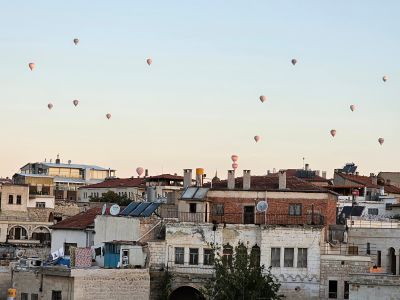
Hot air
balloons over Kapadokya, early morning
Semih explained
to us that the surface of the region is covered by a form of rock that is called
"tuffa," volcanic material that has gone through a sedimentary process. He
pointed out the different layers and colors of rock, and the stages of erosion
leading to the "towers"—peri bacaları,
or
"fairy chimneys." People have been living in them for perhaps 2,000 years.
Today, there are only a few families left in the caves or rocks.
The geology of Kapadokya remains as it has been for millennia, but the
atmosphere in the towns has changed since I was last there about 20 years ago.
Downtown
Göreme
has become somewhat of a Disneyland,
with dozens of distracting knick-knack shops and hundreds of tourists from
everywhere between Peru and China, behaving as if shopping is the reason they
came to Kapadokya. We are tourists, but we convince ourselves that we're not
"that kind."
Nevertheless, what nature has done with the surroundings of
Göreme
remains the same: astonishing.
The outskirts of
the town contain a complex of eroded tuffa hills that were dotted with hundreds
of carved-out dwellings from ancient times.
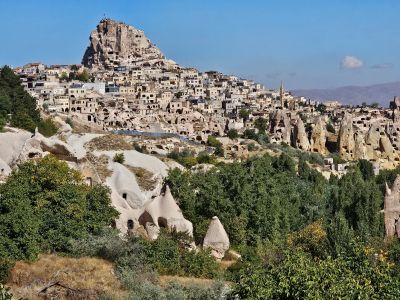
View of
Göreme
In the early
Christian period, according to Semih, Christians formed communities on the coast
of Anatolia. But the Romans of that era didn't like Christians and drove them up
into the hinterland, to Kapadokya. They settled in this area and created
churches in the stone, some of them complete with frescoes that you can still
see. Semih said that the Christian civilization that eventually took over the
area was not "Byzantine," but "Eastern Roman."
Anatolia was heavily populated by Greek Christians before the Turkish population
arrived from the east in the late centuries of the first millennium CE. After
the Greek invasion and war in 1923, there was a population exchange and most of
the Greeks who lived in Anatolia, including those in Kapadokya, were compelled
to leave and move to Greece. Most of the Greek residents in the "towers" and
caves of Kapadokya emigrated, and often their homes were taken over by Turkish
farmers. On the outskirts of
Göreme
we entered
and examined the largest of the ancient churches, still complete with beautiful
frescoes.
Near
Ürgüp,
Semih took us to the now defunct Keslik monastery. The old frescoes there had
been defaced by tourists as long ago as 150 years—with writing in Greek and a
date of 1883. Semih explained that Greek tourists came from Greece and took
parts of the frescoes, thinking that if they ingested them, by dipping them in
their tea, that would cure whatever ailed them.
From
Kapadokya we took a six-hour bus ride southwest to the city of Antalya. We
crossed the majestic Taurus mountains and headed west along the Mediterranean
for a spell, arriving at the bustling city after dark. We settled in the crowded
Kaleiçi
neighborhood with its narrow winding streets and a well-preserved Ottoman
atmosphere. From Antalya you can visit ancient Greek and Roman ruins at Side,
Manavgat, Aspendos, and Pirge.
In Antalya itself there is Hadrian's Gate, incorporated into the wall around
Kaleiçi.
And by far the most lovely part of the neighborhood are the spots above the sea
or, down lower, the port area just by the waterfront at Mermerli Beach.
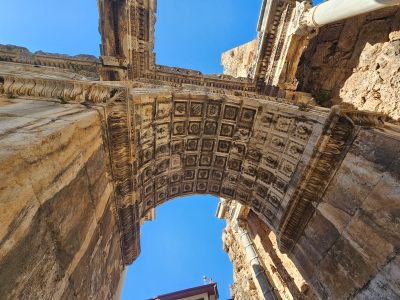
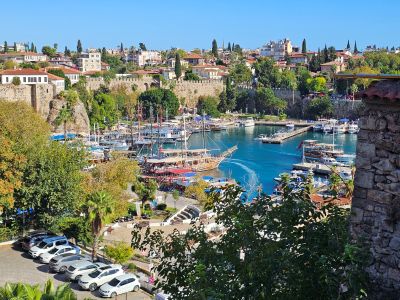
Hadrian's
Gate, Antalya
Mermerli
Beach, Antalya
Our
visit to our friends Ceren and Nazan took us out of the touristic world and
added a friendly dimension to our stay in Antalya.
The Turkish friends we visited, and those we met along the way, struck us as
unusually friendly, courteous, and helpful. We would return to Turkey in a
heartbeat.
*
From Hilmi, about the street population:
"Half
moon"
I am a street cat
İ spy on the shadows
While you sleep at night
I find no food, sometimes I'm thirsty
I lie down on a balcony
I stare at the stars and eat them
I bite the moon
I leave the other half for you.
MACEDONIA
Leslie flew home, and I took a short flight to Skopje as an interim stop on my
way to Bosnia. This visit had the weight of a pilgrimage for me, as I have
"family" there—family, in all but blood relationship. This connection started in
the spring of 1989, when I was living in New York City for a few years, and
Jahja Gjakova came and visited "for a short time." He ended up staying for a few
months, and later that summer Carla and I visited him at his home in Skopje.
There, he maintained a shop of traditional handicrafts in the old section of
Skopje, in the "Bit Pazar." That is an open-air market with dry goods, every
kind of produce, spices, tobacco, tote bags, clothing, fix-it shops, and so much
more. During that summertime visit Jahja took us around Kosovo, to the markets
where he was buying traditional hand-made artifacts for his shop.
This was the beginning of my ever-closer relationship with Jahja and his
extended family. Those were days of modest means and relatively simple
living—also the time of Yugoslavia falling apart. In that part of the country,
the Albanians were going to get the worst of it. Jahja's relatives were spread
between Macedonia and several parts of Kosovo: Prishtina, Peja, Gjakova, and
Prizren. In 1998 the family members in Kosovo were displaced to Macedonia and
elsewhere; in 2001, during the mini-war in Macedonia, other parts of the family
were displaced to a now-independent Kosovo.
Jahja was the kind of person who always landed on his feet, an archetypal,
well-connected and capable, multi-lingual uncle who could set things up for many
of the nieces and nephews in different ways. He contacted me to help find a
living place in the US for one nephew who needed to leave the country. It also
happened that one of his nieces—someone who also needed urgently to leave
Kosovo—lived with me for a couple of years while finishing high school. These
things, and more, created a family relationship between me and the Gjakova clan.
Sadly Jahja, my best friend in Macedonia, died in a ventilator at age 62 in the
early period of the pandemic. This was, of course, a shock for all of his
friends and family. So I returned to Skopje, for the first time since 2013, to
pay my respects and to rekindle the relationship. There I was greeted by Jahja's
and Didare's son and two of their three daughters, a grand-daughter, along with
one husband and one long-term partner. Within the short period of a welcoming
dinner I was brought back into the extended family, with all of us catching up,
and telling our stories, sharing a quick and intensive re-acquaintance. The next
day we visited Jahja's grave together, joined by Jahja's brother Naim.
Skopje is much as it was the last time I visited, with the main square
resembling a shop for used statuary all the way up to an equestrian Alexander
the Great, and conspicuously missing any remembrance of the 45-odd years of the
post-WWII socialist period. Thus is history effaced and re-written.
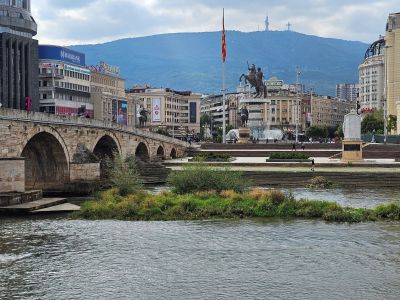
Statue of
Alexander the Great, main square, and part of the Kameni Most (Stone Bridge)
Skopje
Here and there
around the town I noticed Palestinian flags and pro-Palestine posters displayed
prominently.
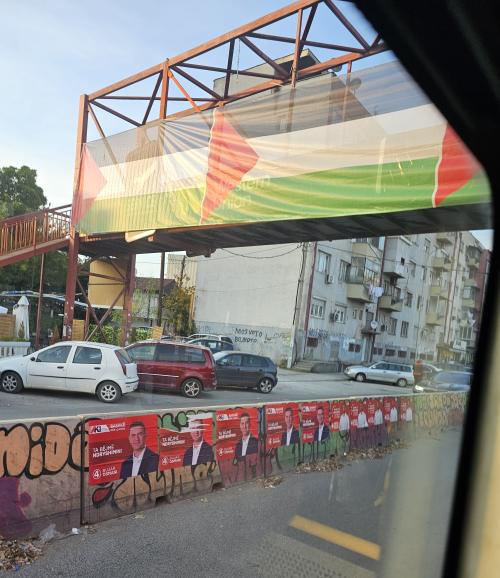
Palestinian flags on an overpass,
Skopje
Walking across
the Kameni Most—the stone bridge—to the old section, I was captivated by the
solo busking/clarinet playing of Asan Bobi, who I stopped and listened to, and
then talked with, for a while. He is a freelance Romani musician of great skill
and expression. A short way farther up from the bridge is the
čaršija district, or market area. This still retains its old architecture, but
the shops have been boutiqued, brought up a notch in the commercial level.
However, there are still the characteristic divisions of goods, with a row just
of wedding dresses, and another row devoted to jewelry.
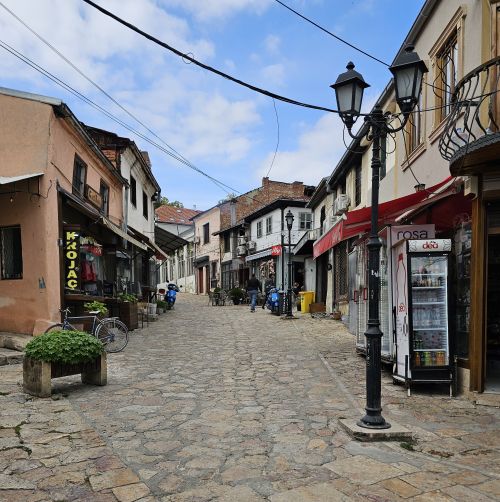
The
Čaršija, Skopje
At the end of the čaršija stands the expansive Bit Pazar, with its array of
goods as I've described it above. It's a busy place, but the keepers of the egg
stalls, produce stalls, meat shops on the edges, and cheap clothing racks still
find time to stop and share a cup of tea from the one or two improvised tea
booths situated strategically under the vast roof of the market. On the side
streets you can buy t-shirts, vacuum cleaners, Albanian flags, and loose
tobacco, among other things.
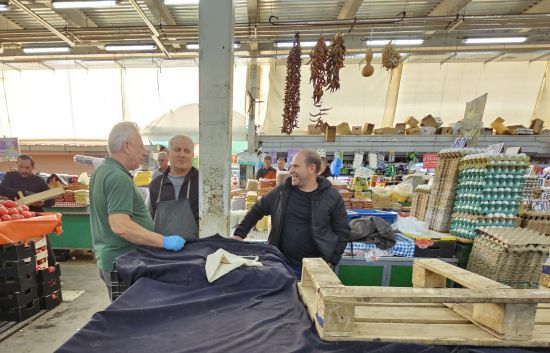
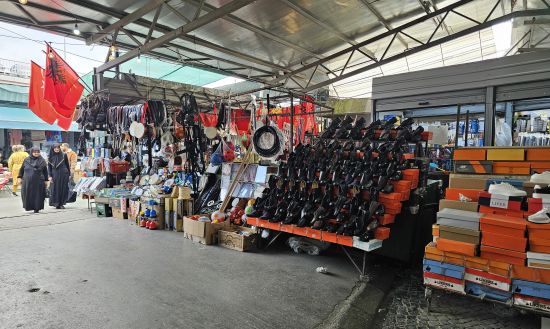
History moves on—but for now, the bit Pazar retains its old, bustling
atmosphere.