Bosnia, Fall 2025
REVISITING THE ENVIRONMENTALISTS,
OCTOBER 2025
I did not intend to go back to Bosnia this year. Between late 2023 and 2024 I
was there three times for research or for an informal visit. In the fall of 2024
I had an intensive period of meeting environmental activists and seeing their
beloved rivers, mountains, and valleys. After that I spent some months writing a
series of six articles about these meetings and the work of the activists. You
can read those articles
here (or at least look at the photos). It will be good background to this
journal.
I found myself in Turkey, and so it was all but unavoidable to travel to nearby
Bosnia. Given this, I decided to check in with some of the activists I had met
the previous year, and to update my impressions of their work. That worked out
well, as I was also able to meet a few new people and round out my understanding
of the environmentalist movement.
This
journal will, in an informal way, present some things I learned,
along with a couple of personal experiences. This is in contrast with my regular
Bosnia blog. That blog comes out approximately every other
month, and it covers the day-to-day politics of Bosnia ("Dodik did this, Dodik
said that"). It is more directed toward the "Bosnia fanatics" and people who,
like me, feel that they must keep up to date on the latest sordid political
developments. This journal, on the other hand, is for everyone and I only write
it when I've been back to Bosnia.
I approached the activists with a few questions:
--Is there an environmental movement in Bosnia-Herzegovina?
--What is your message to officials of the international community?
--What is a solution to the predominance of coal and to dilemma of international
extractivism?
I took the quick bus ride from Sarajevo to Kakanj in central Bosnia, to visit
Hajrija Čobo. An English teacher and trained attorney, she is
a strong and persistent activist who has led a movement of resistance to the
mining activities around Vareš in central Bosnia. The Rupice mine in that
location is upstream from Kakanj and has seriously compromised the water quality
for an entire community of 40,000 (for background, see my sixth article,
here).
Not so much has changed in the situation between Kakanj and Vareš since my
articles came out. The mine at Rupice began functioning at the beginning of last
year, extracting silver, zinc, lead, gold, copper, and other ores. In September
of this year, the Canadian firm Dundee Precious Metals (DPM) bought the
controlling company, Adriatic Metals, which had run the Vareš operations. The
change of ownership does not herald an improvement in the destructive mining
procedures in the forests outside of Vareš.
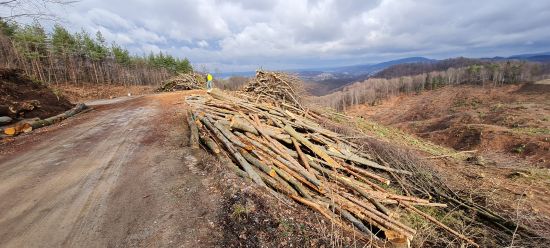
Devastation from mining in central Bosnia
On the contrary, now there is talk about another company, Seven Plus, starting
to mine for chrome. Seven Plus is owned by its founder, the ubiquitous Miloš
Bošnjaković. He was also the founder of Adriatic Metals and, for that matter,
worked for a time as the CEO of Lykos Metals. Lykos has been prospecting both
around Jezero and Ozren
(for background see
part II and
part III, respectively). Its search for strategic metals in both locations
poses a grave threat to the environment and has prompted firm resistance from
the local communities.
The chrome mine near Vareš is no less a threat. Meanwhile, the extraction at
existing mines in the area has caused serious damage, not only due to pollution
of the drinking water downstream, but also to the dumping of tailings near
settled communities such as
Pržići and Daštansko.
Heavy trucks have dominated the roads, raising dust and creating hazards for the
residents. Some of the homes have been structurally destabilized because of the
tailings deposits. The noise, traffic, poisoning of the ground water, and other
pollution have seriously diminished the quality of life for families.
There is protest in these two latter communities, but Majda Ibraković,
a scholar and leading activist in the Bosnia-wide Eko BiH network, notes that
there ıs not more significant resistance to the mining projects around Vareš.
Researching the matter of "corporate growth in vulnerable communities," she
points out that the money
coming into the community—as touted by the mining company, the local mayor, and
the press—works as a lure for the local residents. But the advantages accruing
to the residents of Vareš are nowhere near what they are made out to be.
Majda says that there is a new, very destructive way of mining, which results in
very fast extraction. Majda says that if there must be mining, "let's have our
own mines, and develop our own energy sources." She speaks of the need to
nationalize resources and to grant an amnesty on debts, as they have done in
Africa.
In Kakanj, Majda says, there is resistance around matters other than the
polluted water from Vareš. That afflicted town is home to a coal power plant; a
cement plant; a waste incinerator; and a coal mine. There have been protests in
town about the dangerously high level of sulfur dioxide in the air. Other
protests led to the delay in the establishment of an animal-waste processing
facility. Activists have also demanded increased restrictive measures against
pollution from the power plant.
Throughout Bosnia-Herzegovina there is destructive extraction taking place in
mining projects—and other, ostensiby renewable, energy-producing ventures are
turning out to be damaging to the environment as well. These projects include
the construction of solar- and wind-power farms. Environmentalists have
identified solar and wind power as the alternative to destructive mining for
strategic minerals and to the damaging hydroelectric dams (For background on the
dams, see
part VI of my series). However, domestic tycoons and international
corporations alike are descending on undefended land—often state property which
should be under protection—without oversight, without state control or any
strategic development plan.
The private companies involved in solar and wind development have the unbridled
power to scrape away topsoil on hills above clean rivers and settlements,
unleashing pollution, drainage problems, and potential landslides, along with
noise and encroachment on private farms and communities. Many of these
installations, such as the solar one at Komanje above Stolac, and at Livno,
Ljubuški, and Mostar, are constructed by private profiteers. A Chinese company
is building a wind farm in Tomislavgrad.
Majda notes that in the broader region, there is better environmental control in
Albania and Macedonia: "Construction of power installations must be done with
the consent of the communities. Biodiversity should be protected. The companies
just go into areas with installation plans wherever they wish to, without
control. There should be 'no-go' zones. The permitting process must be better
controlled."
The reason for the lack of control, however, is that the pyramidal power
structure of Bosnia-Herzegovina is ridden with corruption and cronyism from top
to bottom. So everyone from the local mayors and inspectors on up to the entity
ministers and presidents are eager to sell off their land to the highest bidder.
It's a classic rentier/neocolonial operation, as many activists have described
it. I have addressed this in various sections of my
series of articles.
Activist Svjetlana
Nedimović filled out my information about the private companies taking advantage
of chaotic oversight in Bosnia. She agreed that the best forms of energy
production would be wind and solar, but that the projects are being implemented
badly. She commented that, in fact, all energy production hurts the
environment in one way or another. When the mining companies promoting their
projects say things like "We will use the most up-to-date processes, and they
are guaranteed not to pollute," they are lying.
I made a special trip to the lovely central Bosnian town of Maglaj, situated
alongside the Bosna River, to visit Davor
Šupuković and his fellow activist "Denis"
(for background, see
Part III). I had been in touch with them for a couple of years, and traveled
with them to Mt. Ozren a year ago. I sat with them for a few hours in the
cafeteria of the brand-new President Hotel.
The US Treasury Department had just removed long-standing sanctions against
recently deposed Republika Srpska President Milorad Dodik and dozens of his
cronies. This being the Balkans, where there's only the faintest line between
hypothesis and truth, speculation was common about the "deal" Dodik had made
with Trump to get himself off the hook. There are so many theories that one or
two of them may turn out to be correct.
One that Davor promoted was that this was a trade for the lithium located on Mt.
Majevica. Davor predicted that if there are moves made on that resource—at the
expense of this truly lovely expanse of land and the farming that takes place
there—there would be a "strong community reaction...People won't stand for it,
and they will amass in numbers."
I asked how people mobilize. Davor answered, "It takes place differently in
different places. There are non-governmental organizations that bring people
out. There are priests and businessmen who are helping to resist the politicians
who want to bring in international investment at all costs. There are Imams who
have declared that it is an Islamic responsibility to protect nature. And we
have ways of garnering media attention. Davor added, "It only takes between ten
and fifty people to create a physical blockade."
Davor described the multi-pronged approach of organizations with different
expertise in protecting the environment. The biologists, in a way, are on the
front line. As they discover "new" species in a cave or on a mountain, they
build the legal argument for environmental defense and the preservation of
biodiversity. Other organizations participate in public advocacy and education.
The legal approach by advocacy organizations such as the Aarhus Center is also
key.
Davor brought up the ever-present dilemma of land protection. The amount of
Bosnian land protected by parks and other preserved territories remains around a
paltry 3.5%, where in the EU, it is well over 20%. "My message is that we must
establish the same legal standards of protection that exist in the EU," he said.
"We should rebuild agriculture and develop the tourist infrastructure. It is
hard to do this work; we need more people to help. But in the future, we can
either protect our land, or else we will live as if in a mineshaft."
*
After the meeting, I had a few hours before the next (and only) bus back to
Sarajevo departed. This suited me, as the weather was fair and I wished to
explore Maglaj's Old Town across the Bosnia River. I walked from the hotel to
the bridge and crossed the river, turned left in front of a large mosque, and
wandered among the classic Ottoman-style houses on the steep hills. After a
while I hiked up to the walled fortress. As I approached the sturdy gate,
several workmen who had been involved in restoration were leaving. It was 3:00
p.m., and they told me they were leaving for the day and had to lock up. I
whined that I had come all the way from America to see this. One of the men
said, "Ok, just lock this padlock when you leave." So I went in, wandered
around, and looked down on the river and the new town across it. I locked up as
I left.
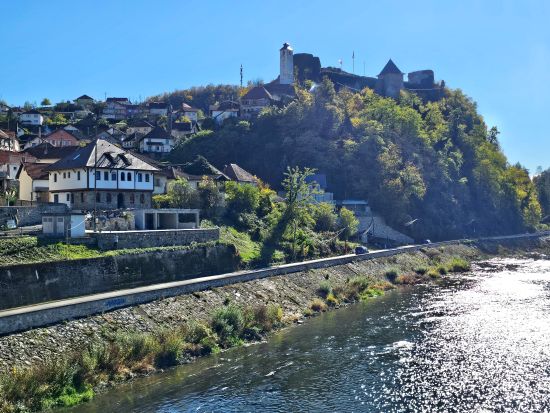
Fortress on the hill in Maglaj, by the Bosna River
I returned to catch my 5:00 p.m. bus, which was nowhere in sight. Some teenagers
were raising a ruckus at the end of the station. I ignored them. After a while
one of them came by and I asked him about the bus. He assured me that it would
arrive, by and by. He asked me, "Are you from here, or from Sarajevo?" I told
him I was from America. A few minutes later he came back with several of his
friends and, pointing to one of them, said, "He doesn't believe you're from
America."
One of the teenagers asked me what I do for a living. I told them that I was a
carpenter. One asked, "Is that the oldest profession in the world?" I said that
I thought there was one older profession. We conjectured about that a bit.
The sky got dark and it began to drizzle. I was reading a book by Bashevis, so I
went into the station office where there was light, to read while I was waiting.
With perfectly wrong timing, the worker informed me that my bus had arrived and
that it was leaving. I ran out to chase the bus. Four or five of the teenagers
joined with me, running through the puddles, waving, and yelling at the bus. It
didn't stop. We gave up and, half-soaked, I walked back to the station, worrying
about my next move. One of the teenagers offered to wipe my glasses dry. He told
me to go into the office and have the worker call the bus to come back for me.
It turned out that had already been done. Within minutes, the bus returned and
picked me up.
Teenagers are ok.
In Maglaj, Sarajevo, Tuzla, Mostar, and Kakanj I noticed a proliferation of
pro-Palestine tee-shirts, flags, posters, banners, and graffiti. The sentiment
in solidarity with Palestine is mainstream in the Muslim-controlled parts of
Bosnia-Herzegovina. Demonstrations and street performances for Palestine have
been a regular occurrence in Bosnia since October 7, 2023, nor were they a
rarity before that date.
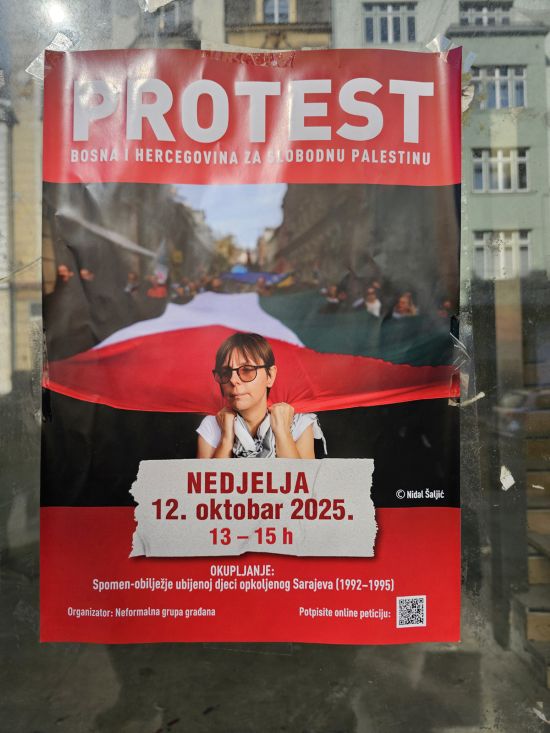
Announcement of a protest in Sarajevo
I visited with Aline, who has been involved with Bosnia about as long as I have.
She has had a focus on Mostar, but has shifted attention to environmental
activism as well. We discussed solar installations around Stolac; magnesium
prospecting at Kupres, and recent developments in Srebrenica.
As our conversation turned to incipient fascism in the United States, Aline
remarked, "This is surreal, having this conversation!" But we know that the
current so-called president (let's call him "DT") has often told us who he is
and what he wants. So what he has been doing is always shocking—but it shouldn't
be a surprise.
In Bosnia I had many conversations with local people, especially activists,
about the political disintegration taking place in the US. Everyone was,
naturally, concerned. The destruction of USAID and withholding of other funds
has seriously hurt the operation of NGOs, from small business and farm relief to
independent journalism. I try to explain what's going on: voter suppression
(almost no one knows the word "gerrymandering"); the ICE assaults; legal
machinations against women; and so much more. People shake their heads and wish
us all luck. They've been through a lot of this.
While I was in Bosnia, the second "No Kings" march took place—mobilizing seven
million people in over 2,500 locations. They say it was possibly the largest
protest in US history. Certainly, there is plenty to protest about, more and
more each day. Seven million is a lot of people. It gets a message out.
There's a lot of talk about the message. But we know that DT doesn't get
messages; he only tweets them. So who does the message go to? It should go to
us, from us to each other. The message of the biggest protest ever should be:
"We're moving; what next?" Because a protest, even one that big, is just an
incident. There have been hundreds of protests in our history that never led to
anything like actual resistance.
As Mario Savio said, "There's a time when the operation of the machine
becomes so odious, makes you so sick at heart, that you can't take part!"
Odious it is, now, isn't it? I think that people who do not ordinarily have the
activist mindset have gotten this feeling. You don't fill the ranks of 7 million
with activists; there just aren't that many. Current events mobilize a greater
number of people to join.
Then there is the next part of Savio's talk, which in effect addresses "what
next": "You can't even passively take part!," he said, "And you've got to put
your bodies upon the gears and upon the wheels, upon the levers, upon all the
apparatus -- and you've got to make it stop! And you've got to indicate to the
people who run it, to the people who own it -- that unless you're free the
machine will be prevented from working at all!!" (See the famous Sproul Hall
speech
here.)
Presumably the millions of ordinary people will mobilize and go to the "what
next" stage, passing out of their comfort zone, when people who can organize
effectively lead the way. That is happening, to some extent. Here and there,
people are shutting down traffic or blocking the entrances of odious
corporations. In Chicago, as I write this, people are taking risks to get in the
way of the ICE goons. They are confronted with the knowledge that their
communities, their teachers, their families, are in direct danger. Soon, we'll
all be confronted with that fact.
I am hoping that concerned people will move on from body-shaming DT and
recycling endless sardonic memes on Facebook, to letting go of "internet
activism"—a minimum of that is enough—and moving to something that has more
impact on the apparatus.
*
I met with Azra Berbić,
key
activist from the
ACT Foundation Atelier for Social Changes, an umbrella organization that
publicizes and supports environmental struggles around Bosnia-Herzegovina. Azra
characterizes the Bosnian environmental movement as one that, in the course of
working for environmental protection, promotes social justice and fights against
neocolonialism—a word I hear regularly from activists in Bosnia. She says that
"not all people working to save their land know this term, but they feel it."
"The environment is a red line," Azra continues. "I'm an ordinary village girl
from near Kakanj, and that background helps me understand the situation...we are
resisting fascism, in fact, by joining to protect nature. We are engaged in a
most honorable struggle for justice."
In the northeastern town of Bijeljina, I met Snežana
Jagodić Vujić, leader of the environmentalist organization Eko Put.
Expanding on what Azra discussed, Snežana
did not mince words:
"There is a semi-literate criminal rabble running this country. They have stolen
everything else, so now they are stealing the land. And they agitate among Serbs
to hate the Muslims. They need to be put in jail, and the resources need to be
nationalized. We need to develop a strategy to change the social system, so that
the well-being of people is number one."
"We need to support natural activities that don't hurt the environment. On Mt.
Majevica they excel at producing cheese, honey, and rakija. A kilo of
blueberries sells for 20 KM [about $12.00], while a kilo of [unrefined] lithium
sells for only four KM."
"In Bosnia-Herzegovina, people are divided now, but the possibilities for unity
are in the environmental work. We in the environmental movement are the most
connected with each other, including across international borders. There is hope
now in Serbia, where sustained protests against corruption have been taking
place. There have been some solidarity demonstrations in Banja Luka and
Bijeljina. We need to strengthen the network of activists from each country, to
think globally and to support each other's local work—it's all the same
struggle. We are trying to renew a rotten and sick social fabric."
I asked, "Who can do this?"
"Each of us who is involved in the struggle."
Addressing the international community, Snežana
said,
"They should make decisions that are environmentally sustainable. They should
hold to the same standards and laws as within the European Union. They talk
about a 'green transition'—that means something clean in the EU, but here, it is
something dirty."
While in the northeast, I went with Andrijana Pekić
to visit the Busija Park and visitor center on Mt. Majevica
(see
Part IV of my series).
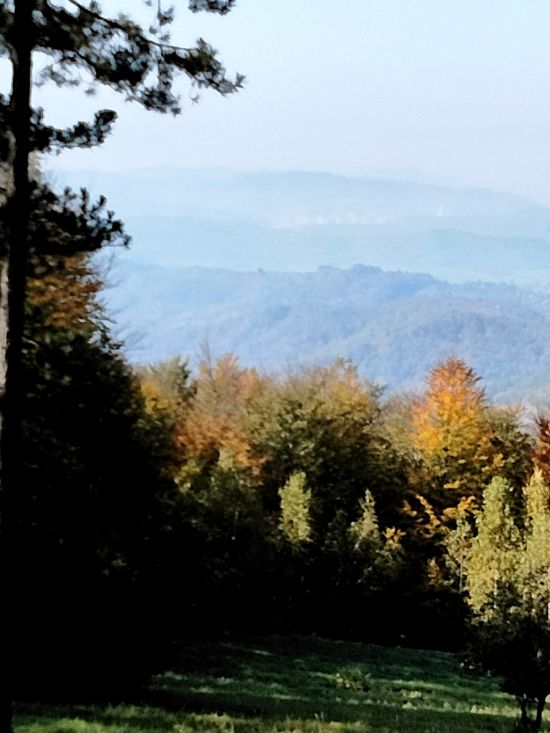
It was a beautiful late-October day,
with a clear sky for the viewing.
From that park, you can look to the west and see nearby Tuzla, and from about a
half-kilometer away you can look to the north and see the town of Brčko. Since I
was there last year, the owner had started construction of a hotel, and had
built a children's slide on the slope of a hill.
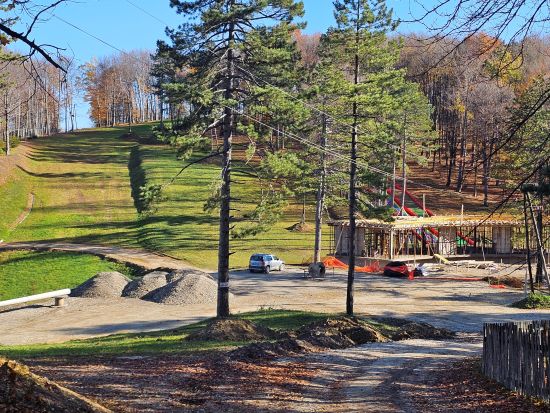
Slide and playfield at
Busija Visitor Center
View to the north from Busija, with
Brčko barely visible
After an expression of distrust last year of the politicians of Lopare (the
regional seat of Majevica), today Andrijana said that "the mayor and the city
council are doing better work now." They have heard the message from the local
people, whose lives would be destroyed by lithium mining. "People are against
the mines," she said. "In Lopare, they know the truth. In [nearby] Ugljevik and
Bijeljina, not so much. There is apathy. People were paid bribes not to sign our
petition" [to create a protected zone on Majevica].
Asked for a message to the international community, Andrijana responded, "Why
don't they just remove some of these dishonest politicians, as they were doing
20 years ago? They should treat us as if we were part of the European Union. The
international community acts as if our land is their property; they don't ask us
anything. They say that all mining work here will be done 'by EU standards,' but
what's really going on is bribery. They want to do here and in Serbia what they
cannot do in Germany. They talk about mining technology that doesn't pollute.
But if such a process existed, they would be mining the lithium that exists in
Germany."
Mostar
I took a couple of days off to visit some friends in Mostar. I stayed at Lamia's
apartment from where, looking through the trees, you could see people crossing
the Old Bridge. Young Benjamin spent his spare time focusing on electronic
technology, while humming tunes non-stop. There's a musician there, waiting to
jam.
My friend Sandro and his father took me to a place I had never been in all these
years: we drove up the long slopes up to Podveležje, the vast plateau to the
east of Mostar under Mt. Velež.
After going up a zig-zag route to an elevation beyond 500 meters, we arrived at
a restaurant and lookout on Fortica Hill. All of Mostar is right there below,
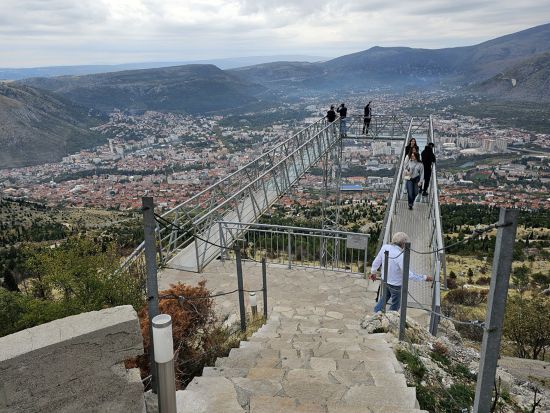
"in the palm of your hand," as they say. The lodge is perched on a steep slope,
and just below its picture window is a U-shaped metal walkway jutting out from
the hill—not for the faint of heart. From the restaurant, and especially from
the walkway, you can pick out the Old Bridge and any of your friends' apartments
that face in the right direction. How did I never go there before?
Lookout walkway
high above Mostar
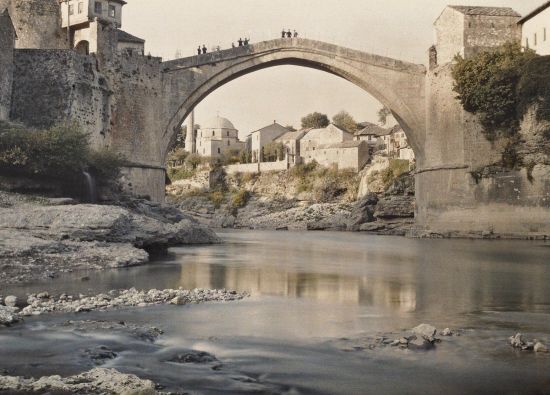
I first visited Mostar in 1981 and enjoyed walking over the Old Bridge and
watching youngsters dive the 30-odd meter drop. One of them would stand on the
railing and wait until tourists had donated enough money to make it worthwhile.
Back then, if you offered some Yugoslav dinars, they would say, "No, no, give me
real money," meaning Deutschmarks.
Croat separatists from the east side of the river, fighting pro-government (by
then mostly Bosniak) forces on the other side, bombed the Old Bridge and knocked
it down on November 9, 1993. November 9 is already a day of ill repute (1938,
Kristallnacht). And the bridge was bombed on a Tuesday. There's a belief among
some Muslims that Tuesday is an unlucky day. July 11, 1995—the day that
Srebrenica fell—was also a Tuesday.
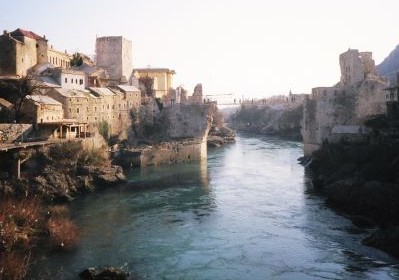
When I returned to Bosnia in 1997, after the war, there was no Old Bridge. There
was a succession of makeshift, swaying bridges constructed over the river. Once,
in the winter of 1999, I arrived to Mostar by bus from Sarajevo, landing in a
torrential rain of the kind that drenched you from head to toe before you could
even think to save yourself. It rained like that all night. By the next morning,
that temporary bridge was gone.
After quite some research, fundraising, rescuing pieces of the stone bridge from
the bottom of river, and consulting the original Ottoman drawings from the 16th
century, the Turks and the Hungarians collaborated to put the Bridge back
together. For a while, people were calling it "the New Old Bridge."
I once had dinner with the architect
Amir Pašić, who had consulted in the planning for the Old Bridge's restoration.
I asked him if it was true, as I had read, that the original stone blocks had
been stuck together with egg yolks and horsehair. He said, "No, but it's a good
story."
The Old Bridge, 1913
Temporary suspension bridge, 1999
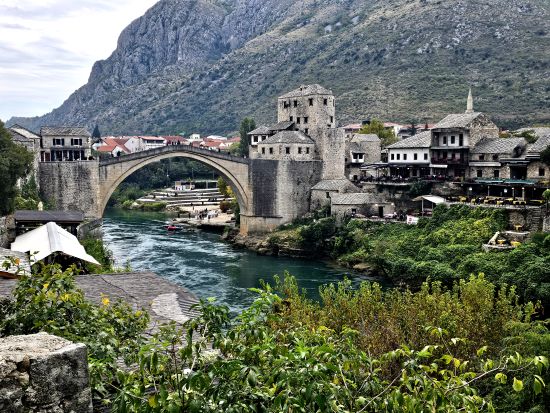
The "New" Old Bridge, 2025
What a foul and dastardly thing to do, to bomb one of the most beautiful bridges
ever, anywhere?
It was the Croat separatist army, the HVO, that did this. Later, six leaders of
the army were convicted of a Joint Criminal Enterprise for committing war crimes
and crimes against humanity mainly against Bosniak civilians. Slobodan Praljak,
one of the generals, had written a tract denying that the HVO had bombed the
bridge.
The six HVO figures were sentenced, variously, to between 10 and 25 years.
Praljak got 20 years, but he did not stick around to serve time. As the sentence
was read out, Praljak swallowed a smuggled vial of poison and died. Before the
war, Praljak had been a dramaturg and theater director. Perhaps the drama of his
way of checking out appealed to his sense of spectacle.
In yet another instance—numbering into the thousands—of the glorification of war
criminals, a statue honoring Praljak was erected in the Croat separatist hotbed
of
Čapljina, in western Herzegovina.
This took place on November 2 of this month, the day after I left Bosnia. The
statue was blessed by a local priest. Glorification of war criminals is a crime
in Bosnia-Herzegovina, and the state prosecutor has opened a case against the
act.
*
Wrapping up my encounters with environmental activists in Bosnia, I visited the
women who run the Sarajevo Aarhus Center. The Center works to support the Aarhus
Convention, named after the town in Denmark where it was drafted. The
Convention, known as the "leading international agreement on environmental
democracy," calls for access to information about environmental issues; public
participation in decisions affecting the environment; and the public's right to
review and appeal on environmental matters. The various Aarhus Centers work to
increase access, transparency, and governmental accountability regarding the
environment.
The Convention was signed by 49 countries, including those in the European
Union; Russia; and Bosnia-Herzegovina. For signatories that have ratified it,
the Convention is binding. There are three or four Aarhus Centers in each of
more than a dozen countries. The Sarajevo Center is the main one of four in
Bosnia.
I met Emina Veljović,
Nina Kreševljaković, Azra Šehić Kustura, and Liljana Meshaj, who received me
graciously. Emina gave me the better part of the visit. She explained to me that
the Center helps educate people and organizations in environmental law, gives
legal assistance, and encourages public participation in legal processes to
defend the environment. The organization collaborates with the Banja Luka-based
Center for the Environment, as well as with the various networks and
organizations, including Eko Put, that are fighting to protect Majevica from
lithium mining.
Emina notes that it is easier to advocate for the environment in the Croat/Bosniak-controlled
Federation than in the Serb-controlled Republika Srpska. Nevertheless, in the
Federation, among other problems, Emina mentioned the notorious air pollution in
Zenica; waste dumping on Mt. Igman; hundreds of neglected quarries around the
country; illegal deforestation near Prozor-Rama; and much more. Aarhus is
involved in fighting the construction of devastating hydroelectric dams in many
places. The Center has worked on twenty legal cases in the past 13 months. Emina
told me that "we don't select organizations to work with; they come to us."
The Aarhus Center was instrumental in getting a law passed in the Bosniak-Croat-controlled
Federation entity that put a stop to the reckless and damaging construction of
mini-hydroelectric dams (See
Part II
of my series). Companies that were bent on constructing these dams "tried to
SLAPP us," Emina said, referring to the widespread, repressive practice called
"Strategic Lawsuit Against Public Participation." In response, in 2023 Aarhus
drafted an anti-SLAPP bill that passed the House of Representatives on the
entity (Federation) level, but it was blocked in the upper chamber, the House of
Peoples. Emina told me that a similar bill has now been presented at the state
level; if it passes, it would compel all lower levels of government to comply.
Together with the Bosnia-wide Eko BiH activist network, Aarhus has also
developed a network with related organizations in neighboring Montenegro and the
rest of the countries of the Western Balkans. Emina noted that the Sarajevo
Center is the leader in fighting mini-hydroelectric dams, and that activists
from the other countries come to Sarajevo to consult with Aarhus on this matter.
Toward the end of my visit, Emina shared an anecdote about a man who visited the
Aarhus Center from the US Embassy. He told her, "The Aarhus Convention should
not be applied in the Vareš area," where one mining company
after another has run roughshod over the environment. Emina commented, "He spoke
as if he had been requested to do so by the investors."
This reminds me of what I wrote in an earlier,
two-part LeftEast series from 2024: "These companies are interested
in profit above all else. A critical aspect of these developments is the
relationship between Bosnian politicians and the corporate representatives also
known as ambassadors, who lobby for the benefit of the companies they
represent."
It is good to know that the environmental movement in Bosnia-Herzegovina is
growing, and that there are organizations like Aarhus poised to help activist
fight the corporations and their representatives.
This ends my Bosnia 2025 journal.